Natural Nootropics: Benefits, Types, and How They Work

We may earn a commission for purchases made using our links. Please see our disclosure for more details.
Some days your mind feels sharp from the moment you wake up. Other days, remembering why you opened a browser tab feels like a challenge. That difference in mental energy is one reason natural nootropics have attracted so much interest.
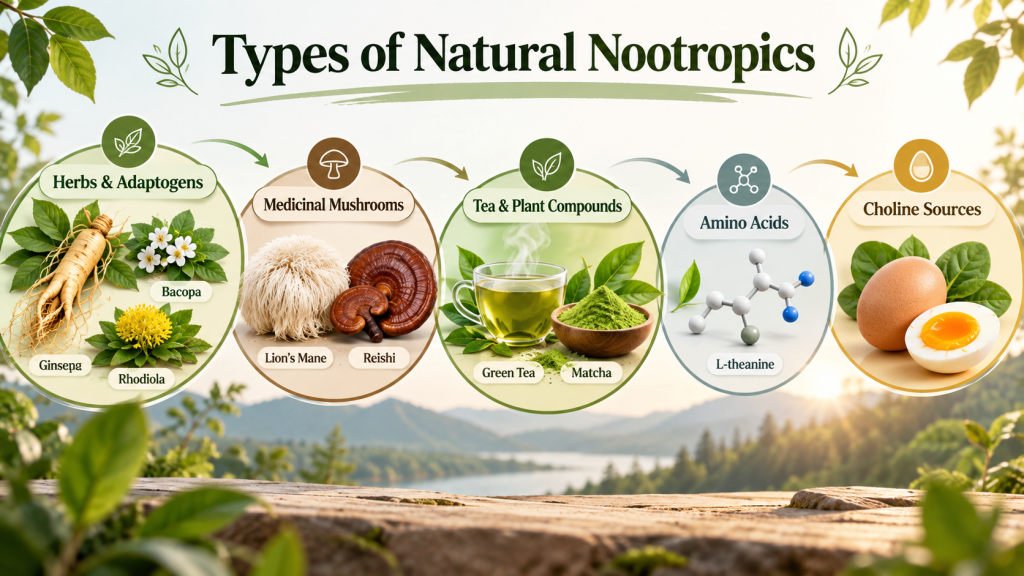
Nootropics are substances people use to support aspects of cognitive performance, such as attention, memory, learning, or mental stamina. Natural options include herbs, mushrooms, amino acids, and compounds already found in foods or produced by the body.
That does not mean every supplement labeled “brain booster” will make you think faster. Research varies considerably between ingredients, and lifestyle still matters more than any capsule. Understanding what each nootropic actually does can help you separate useful options from clever marketing.
What Are Natural Nootropics?
Natural nootropics are naturally derived substances used with the goal of supporting cognitive function or mental performance.
Some have centuries of traditional use behind them. Bacopa monnieri, for example, comes from Ayurvedic traditions. Others, such as L-theanine, occur naturally in tea. Creatine is different again: your body makes it naturally, and you also get small amounts from certain foods.
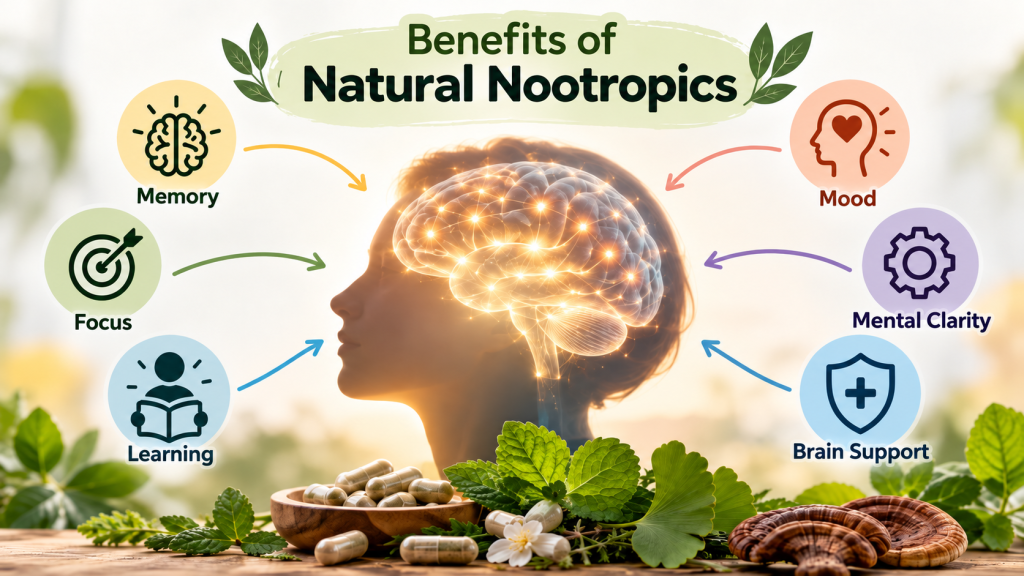
Natural nootropics may be used to support:
- Memory and learning
- Concentration
- Alertness
- Mental energy
- Stress resilience
- Calm focus
- Healthy brain function
The important word here is support. Nootropics do not turn an exhausted brain into a perfectly focused one overnight. Their effects tend to be subtler, and some compounds have much better evidence than others.
How Do Natural Nootropics Work?
There is no single “nootropic pathway” in the brain.
Different compounds act through different biological processes. Some affect neurotransmitters involved in attention and memory. Others influence cellular energy, blood flow, stress responses, or compounds involved in nervous-system function.
Caffeine offers an easy example. It blocks adenosine receptors, which helps reduce feelings of tiredness and increases alertness. L-theanine works differently and is often used alongside caffeine because it may promote a calmer state without strongly sedating you.
Creatine supports cellular energy through the phosphocreatine system. Bacopa contains plant compounds called bacosides that researchers have studied for their potential effects on memory and cognitive performance.
In other words, calling something a nootropic tells you what people hope to get from it—not necessarily how it works.
Potential Benefits of Natural Nootropics
Focus and Attention
Caffeine remains one of the most familiar natural cognitive enhancers. When paired with L-theanine, it may provide a smoother form of alertness for some people.
This combination is popular with students, professionals, and anyone who wants concentration without continually increasing their coffee intake.
Memory and Learning
Bacopa is one of the more extensively researched herbal nootropics for memory. Research generally looks at consistent supplementation rather than a single dose, so it is not the kind of ingredient you take five minutes before an exam.
If Bacopa interests you, our guide to Bacopa monnieri supplements explains how standardized extracts, bacoside content, and whole-herb formulas differ.
Mental Energy
Feeling mentally tired is not always the same as feeling sleepy.
Rhodiola rosea is an adaptogenic herb commonly used when stress and fatigue make concentration difficult. Creatine may also be relevant because the brain requires considerable energy to perform demanding cognitive tasks.
Calm Focus
Being more stimulated does not automatically mean being more productive.
L-theanine is interesting because people generally use it for relaxed alertness rather than stimulation. It can be taken alone, although pairing it with caffeine has become especially popular.
Our comparison of L-theanine supplements covers several forms and serving sizes if you want to explore the ingredient further.
Popular Types of Natural Nootropics
Bacopa Monnieri
Bacopa is one of the best-known herbal nootropics and is mainly studied for memory support.
A 2026 systematic review of Bacopa and Ginkgo found promising results for some Bacopa interventions, particularly for working and short-term memory, although benefits varied across outcomes.
Rather than providing an immediate boost, Bacopa is generally studied with consistent use over several weeks.
L-Theanine and Caffeine
L-theanine occurs naturally in tea leaves. It is commonly associated with relaxation without strong drowsiness.
Caffeine, meanwhile, increases alertness. Combining the two may offer a useful middle ground for people who find caffeine alone too stimulating.
Keep total caffeine intake in mind. Taking a nootropic stack on top of several coffees or energy drinks can quickly turn “extra focus” into restlessness and poor sleep.
Rhodiola Rosea
Rhodiola is an adaptogenic plant traditionally associated with physical and mental resilience.
Rather than functioning like a direct stimulant, it is generally used when stress and fatigue interfere with performance. Research is encouraging in some areas but inconsistent overall, so dramatic promises deserve skepticism.
Lion’s Mane Mushroom
Lion’s mane has become one of the most recognizable functional mushrooms.
Researchers are interested in compounds within the mushroom that may influence nerve-related biological processes. However, human research is still developing. It is better viewed as a promising area of study than a proven memory enhancer.
Creatine
Creatine is best known for exercise performance, but researchers have also studied its role in brain energy and cognition.
A 2024 systematic review of creatine and cognition found that creatine can increase brain creatine levels, although cognitive benefits were inconsistent.
That makes creatine a promising option to study further rather than a guaranteed brain booster.
How to Choose and Use Natural Nootropics Safely
Start simple. Taking six new ingredients at once makes it almost impossible to tell which one helped—or which one caused an unwanted effect.
Look for products that clearly disclose the amount of each active ingredient. With botanical extracts, check whether important compounds are standardized rather than relying on a huge front-label milligram number.
Third-party testing is another useful quality signal. It does not prove that a supplement will improve cognition, but it can provide more confidence that the contents match the label.
Most importantly, remember that natural does not mean risk-free. Herbs and supplements can cause side effects or interact with medications. Speak with a qualified healthcare professional before starting a new supplement if you take medication, manage a medical condition, are pregnant or breastfeeding, or plan to combine several products.
Recommended Natural Nootropic Products
1. Nootropics Depot Bacognize Bacopa Monnieri
This is a useful option for shoppers who want a standardized Bacopa extract rather than an unspecified whole-herb powder. Bacognize is standardized for bacosides, making the formula easier to compare with research-oriented Bacopa products.
Best for: Memory-focused supplementation.
2. Sports Research L-Theanine
Sports Research uses Suntheanine, a branded form of L-theanine, in a straightforward softgel. It works well for people interested in calm focus or in pairing L-theanine with their usual source of caffeine.
Best for: Relaxed concentration.
3. NOW Sports Creatine Monohydrate Powder
Creatine monohydrate has a much broader research base than many trendy nootropic blends. NOW Sports provides a simple powder without requiring you to buy a complex multi-ingredient formula.
Best for: People interested in physical performance alongside potential cognitive benefits.
4. Host Defense Lion’s Mane Capsules
Host Defense offers lion’s mane in a convenient capsule format. It may appeal to people curious about functional mushrooms and emerging research into nervous-system and cognitive health.
Best for: Exploring mushroom-based nootropics.
5. NOW Foods Rhodiola Rosea
NOW Foods Rhodiola provides a single-herb option for people more interested in mental fatigue and stress resilience than direct stimulation.
Best for: Demanding periods when stress and fatigue affect mental energy.
Conclusion
Natural nootropics are most useful when you treat them as tools rather than shortcuts. Ingredients such as Bacopa, L-theanine, Rhodiola, lion’s mane, caffeine, and creatine work in very different ways, and their research support is equally varied. That is why choosing a supplement based on a specific goal makes more sense than buying the bottle with the longest ingredient list. Start with sleep, nutrition, movement, hydration, and stress management. Then, if a well-researched nootropic fits your needs, introduce one ingredient at a time and pay attention to how you respond. A smarter supplement routine is rarely the biggest stack. Usually, it is the simplest one you can actually evaluate.
FAQs
What are the best natural nootropics?
There is no single best choice for everyone. Bacopa is commonly studied for memory, L-theanine and caffeine for attention, Rhodiola for fatigue and stress resilience, and creatine for cellular energy. Your goal should guide your choice.
Do natural nootropics really work?
Some have promising human evidence, while others rely heavily on preliminary studies or traditional use. Results also depend on the ingredient, extract, dosage, duration of use, and individual taking it.
How long do natural nootropics take to work?
It depends on the compound. Caffeine can affect alertness quickly, while herbs such as Bacopa are generally studied over several weeks of consistent use.
Can you take several nootropics together?
Some ingredients are commonly combined, but starting with one at a time is easier and safer. It helps you identify benefits, side effects, and interactions instead of guessing which part of a large stack is responsible.
Are natural nootropics safe to take every day?
Some may be appropriate for regular use in healthy adults, but safety varies by ingredient, dose, health status, and medication use. Follow product directions and speak with a healthcare professional when you have medical conditions, use prescription medicines, or plan to combine multiple supplements.