
Top 10 Red Light Therapy Lamp
We may earn a commission for purchases made using our links. Please see our disclosure for more details.
Red light therapy has moved well beyond specialty wellness clinics. You can now find compact desktop lights, standing lamps, powerful panels, and larger body-coverage systems designed for convenient home sessions.
The tricky part is figuring out which red light therapy lamp is actually worth buying. Many products look nearly identical, yet differences in wavelength, coverage, mounting options, controls, and build quality can make one much easier to use than another.
For this guide, I prioritized established products sold through Amazon, strong customer feedback, practical 660nm red and 850nm near-infrared combinations, and enough variety to suit different budgets and treatment areas. Amazon-market data also shows that lamps and panels using these two wavelengths remain among the most common configurations in the category.
Our Top Picks
| Product | Best For | Key Feature | Rating | Read More |
| Viconor Red Light Therapy Lamp | Best Overall | Adjustable stand, 660nm + 850nm | ★★★★⯪ | Read review |
| LifePro BioHeal 120 LED Panel | Full-body coverage | 120 dual-chip LEDs | ★★★★⯪ | Read review |
| Hooga HG500 | Larger panel | 100 high-output LEDs | ★★★★⯪ | Read review |
| Hooga HG300 | Everyday home use | Compact 60-LED panel | ★★★★⯪ | Read review |
| Hooga HG200 | Small spaces | Compact tabletop design | ★★★★⯪ | Read review |
| Mito Red Light MitoMIN 2.0 | Premium compact pick | High-quality targeted panel | ★★★★⯪ | Read review |
| Hooga Red Light Therapy Bulb | Best budget bulb | Standard socket design | ★★★★⯪ | Read review |
| Viconor Adjustable Panel Lamp | Best value stand lamp | Freestanding adjustable panel | ★★★★☆ | Read review |
| Skylaxy Dual Panel Lamp | Wider coverage | Two-panel setup | ★★★★☆ | Read review |
| YOEYOU 10-in-1 Therapy Lamp | Most versatile | Stand, panel and belt setup | ★★★★☆ | Read review |
Best Red Light Therapy Lamp Reviews
1. Viconor Red Light Therapy Lamp — Best Overall

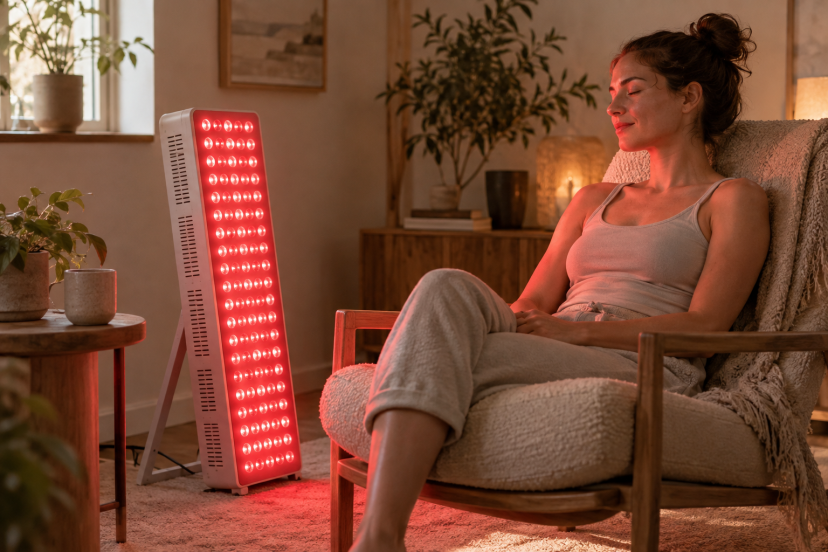
Viconor’s standing lamp is one of the easiest options to work into a normal home routine. Instead of finding somewhere to hang a heavy panel, you can move the stand beside a bed, couch, chair, or workout area and position the light where you need it.
It combines 660nm red and 850nm near-infrared light. Recent Amazon-derived review data showed roughly a mid-4-star rating with hundreds of reviews, with buyers particularly liking its value and adjustability.
Key features: 660nm and 850nm LEDs, adjustable stand, face and body positioning
Best for: Buyers wanting a simple freestanding lamp
Pros: Easy positioning; good value; useful for targeted areas
Cons: Stand takes more floor space than a small panel
Why I recommend it: It offers one of the better combinations of price, coverage, and hands-free positioning.
2. LifePro BioHeal 120 LED Panel — Best for Broader Coverage

The LifePro BioHeal is a step up if a small face-sized lamp feels too limiting. Its 120 dual-chip LEDs combine 660nm red with 850nm near-infrared light, and the panel measures roughly 20 inches tall.
You can use it standing, lying down, or mounted, and its controls include multiple modes and a timer. Recent product data showed around 800 reviews with a strong mid-4-star average.
Key features: 120 dual-chip LEDs, 660nm + 850nm, timer, multiple modes
Best for: Larger treatment areas
Pros: Broad panel; flexible mounting; established brand
Cons: More expensive and less portable than small lamps
Why I recommend it: The larger panel reduces the amount of repositioning needed during a session.
3. Hooga HG500 — Best Larger Panel

Hooga’s HG500 hits a useful middle ground between tiny desktop lights and very expensive full-body towers. It uses 100 LEDs and provides both 660nm red and 850nm near-infrared output.
The HG500 has accumulated well over 1,000 customer reviews in marketplace data, with an average around 4.6 stars. It also includes active cooling and mounting hardware.
Key features: 100 LEDs, 660nm + 850nm, cooling fans, hanging kit
Best for: Torso, back, legs, and larger areas
Pros: Strong review history; larger coverage; solid metal construction
Cons: Heavier than tabletop panels
Why I recommend it: You get noticeably more coverage without moving into the price territory of huge full-body systems.
4. Hooga HG300 — Best Everyday Home Panel

If the HG500 feels bigger than you need, the HG300 is the more manageable alternative. Its 60 LEDs make it well suited to the face, shoulders, knees, or one targeted muscle group at a time.
Amazon marketplace data has shown the HG300 holding around a 4.5-star average with hundreds of ratings.
Key features: 60 LEDs, 660nm red, 850nm near-infrared, hanging kit
Best for: Targeted daily sessions
Pros: Proven design; compact; straightforward controls
Cons: Limited coverage compared with HG500
Why I recommend it: It skips unnecessary extras and focuses on a simple panel format that is easy to use consistently.
5. Hooga HG200 — Best for Small Spaces

The HG200 is even smaller, making it a good choice if you want something that can sit on a desk, nightstand, or small table.
Its 40 LEDs provide both red and near-infrared output, while a built-in timer and selectable light modes keep operation simple. Marketplace data shows a strong review average with more than 500 customer reviews.
Key features: 40 LEDs, timer, cooling fan, selectable red/NIR modes
Best for: Face, hands, knees, and other targeted areas
Pros: Compact; portable; easy to store
Cons: Too small for efficient full-body sessions
Why I recommend it: It’s a practical introduction to panel-style red light therapy without dedicating half a room to the equipment.
6. Mito Red Light MitoMIN 2.0 — Best Premium Compact Pick

Mito Red Light targets shoppers who care more about build quality and brand support than finding the cheapest panel possible.
The MitoMIN 2.0 is designed primarily for the face, neck, and smaller body areas. Current Amazon-market tracking shows it maintaining a strong rating, though it has fewer total reviews than the long-established Hooga or LifePro models.
Key features: Compact premium panel, red and near-infrared output
Best for: Premium targeted sessions
Pros: Solid construction; compact footprint; reputable specialist brand
Cons: Expensive for its size
Why I recommend it: It’s a better fit for buyers who prefer a specialist red-light brand and don’t need full-body coverage.
7. Hooga Red Light Therapy Bulb — Best Budget Bulb

Not everyone needs a dedicated panel. Hooga’s therapy bulb screws into a compatible socket, making it inexpensive and easy to position with a clamp lamp or adjustable fixture.
It combines 660nm and 850nm output and has accumulated more than 1,000 customer reviews with a strong average rating.
Key features: 660nm + 850nm, standard bulb format, targeted beam
Best for: Budget-conscious buyers
Pros: Affordable; compact; easy to replace or reposition
Cons: Much smaller coverage than a panel
Why I recommend it: It’s one of the simplest ways to try targeted red and near-infrared light without buying a large device.
8. Viconor Adjustable Panel Lamp — Best Value Stand Lamp

This Viconor model uses the familiar 660nm and 850nm combination but adds an adjustable freestanding base. That’s useful when you want to target different body areas without mounting hardware on a wall or door.
The model has accumulated thousands of ratings in Amazon-derived review data, although its overall score sits closer to the lower edge of our preferred range.
Key features: Freestanding design, adjustable positioning, dual wavelengths
Best for: Hands-free home use
Pros: High review volume; affordable; easy to move
Cons: Stand can feel less sturdy than premium systems
Why I recommend it: Few options in this price range give you such flexible positioning.
9. Skylaxy Dual Red Light Therapy Panels — Best for Wider Coverage

Skylaxy approaches coverage differently by supplying two lightweight panels. You can position them together for a wider illuminated area or separate them when targeting different sections of the body.
Verified product data shows 660nm and 850nm LEDs and a low-to-mid 4-star customer average.
Key features: Two panels, adjustable stands, 660nm + 850nm
Best for: Buyers wanting flexible coverage
Pros: Two-light setup; lightweight; adaptable
Cons: Smaller review base than leading brands
Why I recommend it: Two movable panels can be more useful than one fixed light for awkward treatment angles.
10. YOEYOU 10-in-1 Red Light Therapy Lamp — Most Versatile

YOEYOU’s system is aimed at people who aren’t sure whether they want a traditional lamp, tabletop setup, or something closer to a wearable device.
The curved light section can be used with its stand and accessories to target areas such as the legs, shoulders, back, and waist. Its review count is lower than our top picks, but the flexible configuration gives it a niche the standard flat panels don’t fill.
Key features: 660nm + 850nm, stand, curved panel, multiple configurations
Best for: Flexible positioning
Pros: Versatile; larger curved treatment area; multiple setup options
Cons: More pieces to assemble and store
Why I recommend it: It’s worth considering when one fixed panel won’t suit every area you want to target.
What to Look for in a Red Light Therapy Lamp
Start with wavelengths. Many home devices combine visible red light around 660nm with near-infrared light around 850nm. Don’t assume that a higher wattage number automatically means a better device—coverage, irradiance at your actual treatment distance, beam angle, and session setup matter too.
Next, think about how you’ll actually use it. A compact panel works nicely for your face or knee, while a larger panel saves time if you routinely want to expose your back, thighs, or torso.
Mounting matters more than it sounds. A powerful lamp that takes five minutes to set up tends to collect dust. Stands, door-mounting hardware, built-in timers, and independent wavelength controls can make regular use much easier.
Red light therapy should also be treated as one part of a broader wellness routine rather than a replacement for sleep, movement, nutrition, or appropriate medical care. These daily habits that support long-term brain health are a useful place to start if you’re building a more complete routine.
Final Thoughts
The best red light therapy lamp depends mostly on how much coverage you need. For a freestanding, easy-to-position setup, the Viconor Red Light Therapy Lamp is my best overall pick. The LifePro BioHeal 120 LED Panel makes more sense for larger areas, while the Hooga HG200 is easier to fit into a small room. If you’re experimenting on a smaller budget, the Hooga therapy bulb is a sensible starting point. Whichever device you choose, look beyond bold wellness claims and prioritize useful wavelengths, manageable coverage, solid construction, and a setup you’ll actually use consistently.
FAQs
What wavelength is best for a red light therapy lamp?
Many home devices combine 660nm red light and 850nm near-infrared light. The combination is popular because it gives users both visible red and near-infrared output in one device.
How long should you use a red light therapy lamp?
Follow the instructions supplied with your specific device. Session length can vary depending on output intensity, distance from the lamp, treatment area, and manufacturer recommendations.
Is a red light therapy panel better than a bulb?
A panel generally provides a larger treatment area and more even coverage. A bulb is cheaper, more portable, and works well when you only want to target a small area.
Should I buy a standing or hanging red light therapy lamp?
Choose a standing lamp if you frequently reposition the device between the face, shoulders, knees, and other areas. Hanging panels tend to work better when you have a dedicated treatment spot and want broader coverage.
Can I use red light therapy every day?
Some manufacturers design their devices for frequent use, but recommended schedules vary by product. Start with the manufacturer’s instructions rather than assuming that longer or more frequent sessions are automatically better.