The Best Vitamins for Mental Clarity & Focus

We may earn a commission for purchases made using our links. Please see our disclosure for more details.
Feeling mentally foggy or struggling to focus can have several causes, including poor sleep, stress, dehydration, and nutrient deficiencies. Certain vitamins for mental clarity may help support normal brain function, especially when your diet is lacking key nutrients.
Vitamin B12, B6, folate, and vitamin D all play roles in the nervous system, energy metabolism, and cognitive health. In this guide, we’ll look at which vitamins matter most, what the research says, and how to choose a supplement that fits your needs.
What Does Mental Clarity Actually Mean?
Mental clarity is not a medical diagnosis. People usually use the term to describe feeling alert, focused, mentally organized, and able to recall information without struggling.
When clarity drops, you might find yourself rereading the same paragraph, forgetting small details, losing your train of thought, or having trouble concentrating.
Nutrition can be part of the picture, but it is rarely the whole picture. If brain fog has become a regular problem, this guide to brain fog supplements and common causes of poor focus offers a broader look at factors that may affect concentration.
Can Vitamins Really Improve Mental Clarity?
Yes—but there is an important catch.
Vitamins tend to make the biggest difference when you are not getting enough of a particular nutrient. Correcting a vitamin B12 deficiency, for example, can address symptoms such as fatigue, confusion, and poor memory. Taking extra B12 when your levels are already adequate is much less likely to deliver a noticeable cognitive boost.
Think of vitamins as nutrients your brain needs to function normally rather than stimulants that suddenly make it work above normal capacity.
Vitamin B12: Important for Nerves and Brain Function
Vitamin B12 deserves a place near the top of any discussion about vitamins for mental clarity.
Your body needs B12 for healthy blood cells and normal nervous-system function. Deficiency can cause fatigue, weakness, confusion, memory problems, and neurological symptoms.
People at higher risk of inadequate B12 include older adults, strict vegans, people with certain digestive conditions, and those who have difficulty absorbing the vitamin.
If you suspect low B12, testing is more useful than blindly taking increasingly large doses. NIH also notes that supplemental forms such as methylcobalamin and cyanocobalamin have not been shown to differ clearly in effectiveness for most people.
Folate: Vitamin B9 for Healthy Brain Chemistry
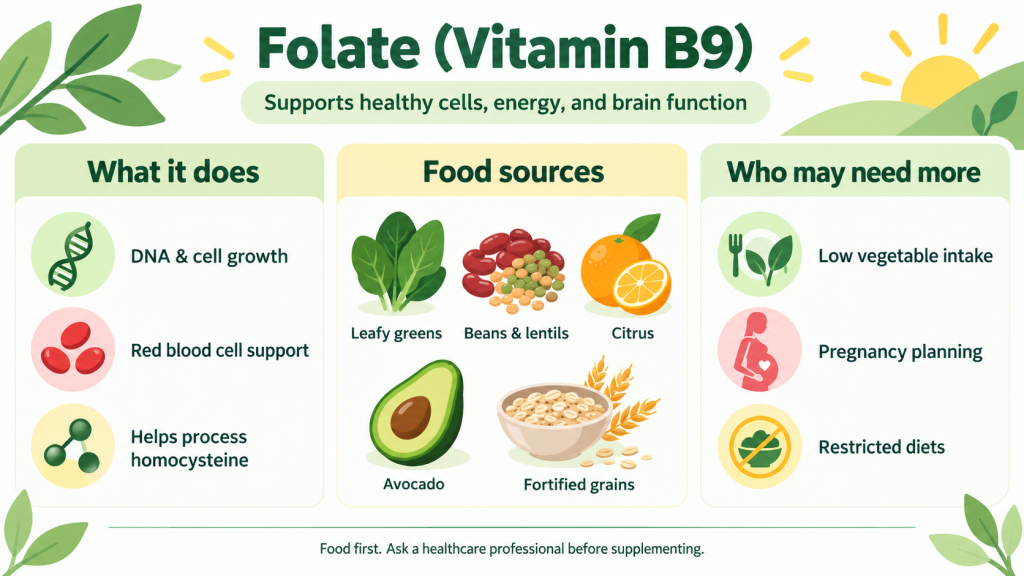
Folate, or vitamin B9, works closely with vitamins B6 and B12. Together, these nutrients participate in processes involved in red blood cell formation and homocysteine metabolism.
Low folate intake can contribute to anemia and fatigue, which certainly does not help concentration.
You can get folate naturally from leafy vegetables, beans, peas, oranges, and fortified grains. Supplements commonly contain either folic acid or forms of methylfolate.
More is not automatically better, though. Taking large amounts of folic acid can sometimes mask signs of vitamin B12 deficiency, so it makes sense to look at your overall nutritional picture rather than treating each vitamin separately.
Vitamin B6: Useful, but Avoid Megadoses
Vitamin B6 helps the body carry out numerous reactions involving metabolism and nervous-system function. Good food sources include fish, poultry, potatoes, fortified cereals, chickpeas, and some fruits.
B6 is included in many B-complex products marketed for energy and mental performance.
This is one vitamin where checking the dosage matters. Long-term intake of excessive supplemental B6 can damage nerves. NIH lists an adult upper limit of 100 mg per day in the United States, while European authorities have adopted a considerably lower limit.
For everyday use, there is little reason to assume that an extreme dose is better.
Vitamin D: Worth Checking if Your Levels Are Low
Vitamin D is best known for bone health, but nerves and other tissues also depend on it.
Low vitamin D levels are common, particularly among people who get limited sunlight. That has led to considerable interest in vitamin D and brain health.
Still, the evidence needs context. Observational research has linked low vitamin D with several health problems, but supplementation has not consistently improved outcomes such as depression in clinical trials.
That makes vitamin D another nutrient where testing can be more useful than guessing, especially before taking high-dose supplements for long periods.
What About a Daily Multivitamin?
A basic multivitamin may make more sense than stacking several individual supplements when your goal is simply to cover minor nutritional gaps.
There is also some interesting research here.
The large COSMOS research program studied multivitamin use in older adults. A 2024 analysis found modest benefits for global cognition and episodic memory across its cognitive studies. However, the research involved adults aged 60 and older, so it should not be interpreted as proof that multivitamins improve concentration in every healthy young adult. Read the COSMOS multivitamin and cognition study.
For another useful perspective, the NIH guidance on vitamin B12 and cognitive function points out that B12 supplements have not consistently improved cognition in people who already have adequate levels.
That distinction matters: fixing a nutrient shortfall and trying to “supercharge” an adequately nourished brain are two very different things.

Who May Benefit Most From Vitamins for Mental Clarity?
Supplements are most worth investigating when there is a realistic reason your nutrient intake or absorption may be low.
That can include following a restrictive diet, being vegan, eating very few nutrient-dense foods, having certain gastrointestinal conditions, taking medications that interfere with nutrient absorption, or being an older adult.
Persistent fatigue or concentration problems deserve more than a supplement experiment. Sleep disorders, anemia, thyroid problems, medication effects, stress, depression, and other conditions can produce similar symptoms.
Daily habits also matter enormously. The strategies covered in these practical ways to improve working memory include sleep, movement, attention management, and nutrition—factors that supplements cannot replace.
Recommended Products
1. Nature Made Vitamin B12 1000 mcg Fast Dissolve
Best for: People specifically looking to supplement B12.
This simple B12 product avoids turning one nutritional goal into a long list of extra ingredients. It may be worth considering for people with low dietary B12 intake or a confirmed need for supplementation.
2. Nature Made Vitamin D3
Best for: People with low vitamin D intake or levels.
Nature Made offers several D3 strengths, including 1,000 and 2,000 IU options currently represented on Amazon. Choose dosage according to your needs rather than automatically buying the highest-potency bottle.
3. Nature Made Folic Acid 400 mcg
Best for: People specifically advised to increase folate intake.
This straightforward folic acid supplement keeps the formula simple. However, folic acid requirements vary, and higher intakes are not necessary for everyone.
4. Thorne Basic Nutrients 2/Day
Best for: Broad daily nutritional coverage.
Rather than buying several separate products, this multivitamin provides a broad range of vitamins and minerals in a two-capsule daily format.
5. Centrum Silver 50+
Best for: Adults over 50 looking for a general multivitamin.
Centrum Silver is particularly interesting because a Centrum Silver multivitamin was used in the COSMOS-Web randomized trial investigating memory in older adults. That does not mean everyone will experience cognitive improvements, but it makes this a more evidence-relevant option for the age group studied.
How to Choose Vitamins for Mental Clarity
Start with the reason you are taking the supplement.
If your diet lacks B12, choose B12 rather than buying a complicated “brain booster” containing fifteen unrelated ingredients. If blood testing shows low vitamin D, address vitamin D.
For general coverage, look for a moderate-dose multivitamin instead of formulas that provide enormous percentages of the Daily Value without a clear reason.
Also look for clear labeling, realistic claims, and reputable third-party testing where possible. Be wary of products promising instant memory enhancement or dramatic IQ improvements.
Safety Matters
Supplements can interact with medications and medical conditions, even when the ingredients sound harmless.
Check ingredient labels carefully before taking multiple supplements together. A multivitamin, B-complex, energy supplement, and “brain formula” may all contain B6, for example, causing your total intake to climb surprisingly high.
Pregnant people, anyone taking prescription medication, and people with kidney, liver, or other chronic conditions should discuss supplementation with a healthcare professional.
Conclusion
The best vitamins for mental clarity are not necessarily the products with the longest ingredient lists or the biggest doses. Vitamin B12, folate, B6, and vitamin D all support processes that matter to normal brain and nervous-system function, while a balanced multivitamin can help cover broader nutritional gaps. The key is matching the supplement to an actual need. Start with diet, sleep, stress management, and movement, and consider testing when deficiency is possible. Supplements work best as nutritional support—not as a shortcut around the basics.
FAQs
What is the best vitamin for mental clarity?
Vitamin B12 is one of the most relevant because deficiency can contribute to fatigue, confusion, and memory problems. However, the best vitamin depends on which nutrients, if any, you are lacking.
Do B vitamins help with brain fog?
They may help when brain fog is related to inadequate intake or deficiency. Evidence does not show that taking large amounts of B vitamins consistently makes well-nourished people mentally sharper.
How long do vitamins take to improve focus?
There is no universal timeline. If a deficiency is contributing to symptoms, improvement may occur after levels begin recovering. Other causes of poor concentration will not necessarily respond to vitamins.
Is it better to choose b12 alone or a b-complex supplement?
Not always. A B-complex can be convenient when several B vitamins are needed, but individual B12 makes more sense when B12 is the specific concern. It also reduces unnecessary exposure to high doses of other B vitamins.
Should I take vitamins every day for better concentration?
Only when they fit your nutritional needs. A daily multivitamin may help cover gaps, but vitamins cannot compensate for chronic sleep loss, dehydration, high stress, poor diet, or an underlying medical problem.