15 Fun Brain Games for Elderly Adults to Stay Sharp
We may earn a commission for purchases made using our links. Please see our disclosure for more details.
Keeping the mind active does not have to feel like homework. The best brain games for elderly adults combine gentle mental challenges with familiar activities, enjoyable conversation, and a sense of achievement.
A crossword at breakfast, a card game after dinner, or a family trivia session can exercise skills such as memory, attention, language, and problem-solving. These activities may also reduce boredom and create valuable opportunities for social interaction.
However, brain games are only one part of healthy aging. They work best alongside regular movement, restful sleep, nutritious food, meaningful relationships, and ongoing learning.
Why Brain Games Can Help Older Adults
Mental games ask the brain to retrieve information, notice patterns, follow rules, and make decisions. Different activities challenge different abilities. Sudoku emphasizes logic, for example, while storytelling draws on memory and language.
Research offers a balanced picture. A systematic review of brain gaming in older adults found that games were not consistently better than other active interventions for improving overall cognition. In other words, brain games are useful activities, but they are not proven cures or guaranteed ways to prevent dementia.
Other research suggests that game-based training may produce modest improvements in specific areas, including processing speed, selective attention, and short-term memory. The benefits often relate closely to the skill being practiced.
Most importantly, enjoyable games encourage older adults to stay curious, engaged, and socially connected. Those are worthwhile goals even when a game’s effects do not transfer to every part of daily life.
For a broader approach, explore these practical daily brain health habits covering movement, nutrition, sleep, learning, and social connection.
How to Choose the Right Brain Game
Start with the person’s interests and current abilities. Someone who loves words may enjoy crosswords, while a former bookkeeper might prefer number puzzles.
The game should feel challenging without causing frustration. Look for large print, clear instructions, strong color contrast, and pieces that are easy to hold. Hearing, vision, and hand mobility can affect whether an activity feels inviting or exhausting.
Avoid treating every game like a test. Offer hints, remove time limits, and celebrate participation. For adults with cognitive impairment, familiar topics and simple matching activities may feel safer than complex new rules.
15 Fun Brain Games for Elderly Adults
1. Large-Print Crossword Puzzles
Crosswords exercise vocabulary, spelling, memory retrieval, and general knowledge. Large-print editions reduce visual strain and make it easier to write answers.
Choose an easy puzzle at first. Completing a few clues builds confidence and creates momentum for harder ones.
2. Word Searches
Word searches provide a calm way to practice visual scanning and sustained attention. They are especially suitable for people who find crosswords too demanding.
Pick themes the player enjoys, such as gardening, travel, food, or classic movies. Familiar words can make the activity more personal.
3. Sudoku
Sudoku uses logic rather than advanced mathematics. Players identify number patterns and rule out incorrect choices, which exercises concentration and reasoning.
Begin with a four-by-four grid or an easy large-print puzzle. A standard difficult puzzle may discourage a beginner.
4. Jigsaw Puzzles
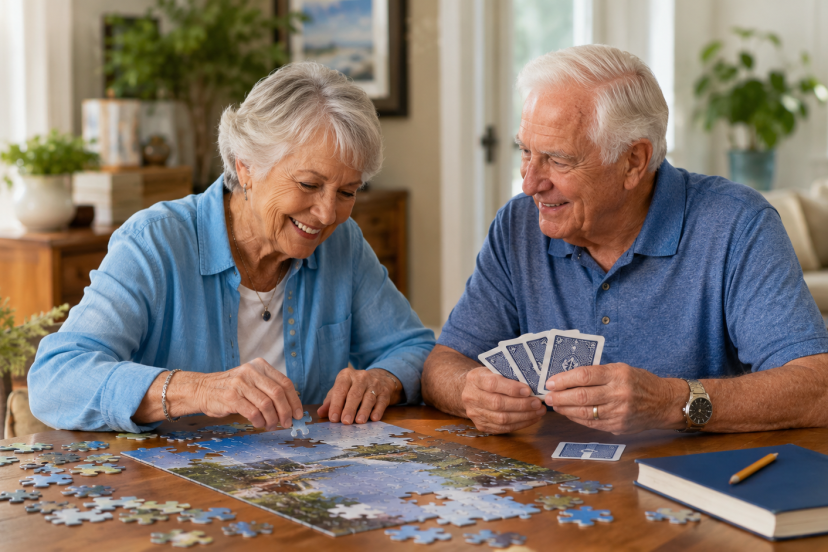
Jigsaw puzzles engage visual perception, spatial reasoning, attention, and problem-solving. They also provide a clear shared goal for families or senior groups.
Select large, sturdy pieces and a recognizable picture. A 100-piece puzzle may offer more enjoyment than a tiny, complicated 1,000-piece design.
5. Matching Card Games
Place pairs of picture cards face down and take turns finding matches. This simple game challenges short-term recall and visual recognition.
Use fewer pairs when playing with someone who has memory difficulties. Photographs of household objects, animals, or familiar places can work well.
6. Trivia Games
Trivia encourages players to recall names, facts, events, and experiences. Questions about music, films, sports, or history from the player’s younger years can also spark conversation.
Keep the tone light. Allow teams, hints, and discussion instead of focusing only on correct answers.
7. Name That Tune
Play a short section of a familiar song and ask the listener to identify its title, singer, or decade. You can also invite them to sing the next line without scoring the result.
Music-related activities often generate stories and emotional connections. Create playlists around favorite genres rather than choosing songs at random.
8. Chess
Chess challenges planning, attention, pattern recognition, and flexible thinking. It works particularly well for older adults who already know the rules.
Beginners can practice with short lessons or simplified positions. There is no need to play a complete competitive match every time.
9. Checkers
Checkers offers strategic thinking with fewer rules than chess. Players must anticipate moves, protect pieces, and adjust their plans.
The familiar format makes it one of the easiest brain games for elderly adults to enjoy with grandchildren or friends.
10. Card Games
Games such as Rummy, Go Fish, Bridge, and Solitaire involve sequencing, memory, strategy, or matching. They are inexpensive and easy to adapt.
Use jumbo-index cards if small symbols are difficult to see. A card holder can help anyone with arthritis or limited hand strength.
11. Category Naming
Choose a category and take turns naming items that belong to it. Examples include fruits, cities, animals, occupations, or things found in a kitchen.
For a harder version, name each item in alphabetical order. For an easier version, provide clues and allow repeated answers.
12. Story-Building Games
One person begins a story with a sentence. Each player then adds another sentence while keeping the story connected.
This playful activity uses listening, imagination, language, and working memory. It also removes the pressure of finding one “correct” answer.
13. Spot-the-Difference Puzzles
These puzzles place two similar pictures side by side and ask the player to find small changes. They challenge visual attention and careful observation.
Choose clear illustrations with limited background clutter. Extremely subtle differences may strain the eyes rather than create useful engagement.
14. Tangrams and Pattern Blocks
Tangrams use geometric pieces to recreate pictures and shapes. Players must rotate, compare, and arrange pieces, which exercises spatial reasoning.
Start with pattern cards that show the piece outlines. Later, try silhouettes that require more independent problem-solving.
15. Digital Brain Games
Tablets can provide adjustable difficulty, immediate feedback, and a wide range of puzzles. Word games, digital jigsaws, strategy games, and even certain video games can offer useful mental stimulation.
A review of commercial computerized cognitive games found mixed results and highlighted differences between products and study methods. Therefore, treat apps as enjoyable practice rather than medical treatment. Choose simple controls, readable text, and limited advertising.
How Often Should Older Adults Do Brain Games?
Consistency matters more than long sessions. A practical starting point is 15 to 30 minutes, three to five times per week. Stop earlier if the person becomes tired, irritated, or uncomfortable.
Variety also helps. Alternate word puzzles with social games, music, crafts, physical activity, and new skills. Repeating one crossword style may improve crossword performance, but a wider routine creates more forms of stimulation.
A supportive lifestyle matters just as much. Balanced meals can contribute essential nutrients, and this guide to the best foods for brain health offers straightforward ideas for everyday eating.
Recommended Brain-Game Products
The following Amazon products suit different abilities and interests. Check current specifications, availability, and prices before ordering.
- Brain Games Large Print Sudoku – Contains more than 160 large-print puzzles and has spiral binding that lets the book lie flat.
- Elfew Large Print Activity Books – A varied set featuring memory games, word searches, mazes, Sudoku, and crosswords.
- Trivia for Seniors: Large Print – Includes more than 500 questions covering music, movies, history, and culture from the 1950s through the 1990s.
- Bicycle Large Print Playing Cards – Features larger indexes and easy-to-see suits for card games such as Rummy, Bridge, and Solitaire.
- Keeping Busy Tile Matching Game – Uses wooden picture tiles for matching, sorting, and memory-based activities.
Conclusion
The most effective brain games for elderly adults are activities they genuinely want to repeat. Crosswords, cards, music, trivia, puzzles, and digital games can all challenge useful skills while adding pleasure and connection to the day. Start at a comfortable level, adapt games when necessary, and value enjoyment over scores. Combined with healthy daily habits, these activities can help older adults stay engaged, confident, and mentally active.
FAQs
Can playing brain games for elderly reduce dementia risk?
Research has not established that any particular game can reliably stop dementia from developing. Games can provide meaningful mental and social stimulation, but they should complement exercise, good sleep, nutritious food, medical care, and social activity.
What is the best brain game for an elderly person?
The best game matches the person’s interests, eyesight, physical comfort, and current cognitive ability. Enjoyment and regular participation matter more than choosing the hardest activity.
Are crossword puzzles good for older adults?
Crosswords can exercise vocabulary, recall, spelling, and concentration. Large-print puzzles with an appropriate difficulty level are usually the most comfortable choice.
What games work well for seniors with dementia?
Simple matching, sorting, music, large-piece puzzles, and familiar trivia may work well. Use clear instructions, avoid time pressure, and adjust the activity to the individual’s abilities.
Can an older adult play brain games every day?
Yes, provided the games remain enjoyable and do not cause fatigue or frustration. Short daily sessions can fit naturally into a balanced routine that also includes movement and social contact.